Quick answer
Phase 1 orthodontic care is early, interceptive treatment for children around ages 6 to 10 that guides jaw growth and creates room for incoming permanent teeth. It does not straighten every tooth; it sets the stage for a simpler second phase later.
Age 7
Recommended first evaluation
Ages 6–10
Typical Phase 1 window
Ages 11–13
Typical Phase 2 start
2 phases
Structure of early treatment
Key takeaways
- Phase 1 care is usually started between ages 6 and 10, when the jaw bones are still developing.
- The American Association of Orthodontists recommends a first evaluation by age 7.
- Phase 1 corrects bite and growth problems early; it does not replace the need for later comprehensive care.
- Not every child needs Phase 1, so a careful evaluation matters more than automatic treatment.
- Titan Dental in Orange, CA offers first evaluations and coordinates care with your child’s general dentistry needs.
What Is Phase 1 Orthodontic Care? (Quick Answer)
Phase 1 orthodontic care is early, interceptive treatment given to a child while some baby teeth are still present, usually between ages 6 and 10. The goal is to correct developing bite and jaw problems before they become harder to fix. As the clinical director at Titan Dental, I think of Phase 1 as guiding growth rather than finishing a smile.
Definition of Phase 1 (early and interceptive) treatment
Phase 1 focuses on the foundation of the bite. It uses growth already underway in a young child to widen a narrow jaw, correct a crossbite, or create space for adult teeth that are still developing. Because bones are still soft and pliable at this age, small changes now can prevent bigger problems later.
What Phase 1 does NOT do
Phase 1 does not straighten every tooth or produce a final, finished smile. Many children still have baby teeth during this stage, so a full alignment is neither possible nor appropriate. Phase 1 is a targeted step, not a complete correction, and most children will still need a second round of care once their permanent teeth arrive.
Why an early evaluation is recommended
The American Association of Orthodontists recommends that every child have a first evaluation by age 7. An early visit does not mean early treatment. It simply lets a provider spot problems while they are easiest to guide and decide whether to treat now or monitor over time. You can read more about the reasoning in the AAO guidance on waiting versus early care.
At What Age Does Phase 1 Treatment Begin?
Phase 1 treatment typically begins between ages 6 and 10, once a child has a mix of baby and permanent teeth. The first evaluation, however, should happen earlier, by age 7, so nothing important is missed.
Recommended first evaluation by age 7
By age 7, most children have their first permanent molars and some front teeth. This gives a provider enough information to assess how the bite is forming. The AAO chose age 7 as a benchmark because problems such as crossbites and severe crowding are usually visible and correctable by then. See the AAO overview of care for children for the full picture.
Why age 7 matters for jaw and tooth development
Age 7 sits in a window of active growth, and the jaw responds well to gentle guidance. Waiting until all permanent teeth arrive can mean the ideal window for guiding bone has passed. Acting during active growth often makes later care shorter and simpler.
Mixed dentition: when baby and adult teeth coexist
The stage when both baby and permanent teeth are present is called mixed dentition. This is the sweet spot for Phase 1 care. A provider can preserve space where baby teeth will fall out, guide erupting adult teeth into better positions, and correct habits before they reshape the jaw.
Why Phase 1 Orthodontic Care Matters for Young Children
Phase 1 care matters because it leverages a child’s natural growth to correct problems that would be far harder to fix once the jaw has stopped developing. Early guidance can reduce the need for more involved treatment later.
Guiding jaw growth while bones are still developing
A child’s jaw is still forming, which means it can be gently widened or redirected. A narrow upper jaw, for example, can often be expanded during Phase 1 without any surgery. The same correction after growth stops may require more complex measures.
Creating space for erupting permanent teeth
When the jaw is too small for incoming adult teeth, crowding follows. Phase 1 can create room so permanent teeth erupt in better positions. This lowers the chance that teeth come in trapped or badly rotated.
Reducing the risk of impacted or crowded teeth
Bite and spacing problems are common in growing children. A review of the research found that a meaningful share of children exhibit some form of bite irregularity that may benefit from early attention, as summarized in this study on the prevalence of bite problems and the need for early treatment. Guiding teeth early can help prevent one tooth from becoming impacted against another.
Correcting harmful habits and bite problems
Habits like thumb sucking and long-term mouth breathing can push teeth out of position and change how the jaw grows. Phase 1 can address these habits while the effects are still reversible. Correcting them early protects both the bite and the surrounding tissues.
Common Problems Phase 1 Treatment Addresses
Phase 1 treatment addresses growth and bite problems that are best corrected during childhood. The most common are crossbites, severe crowding, protruding front teeth, and the effects of oral habits.
Crossbites and underbites
A crossbite happens when upper and lower teeth do not meet correctly, often because the upper jaw is too narrow. An underbite occurs when the lower jaw sits ahead of the upper. Both respond well to early guidance because the jaw can still be reshaped during growth.
Severe crowding and spacing issues
When there is not enough room for permanent teeth, they crowd together or erupt in the wrong place. Phase 1 can create or preserve space so the adult teeth have somewhere to go. This often reduces the amount of correction needed later.
Protruding front teeth and injury risk
Upper front teeth that stick out are more likely to be chipped or broken in a fall or during sports. Bringing these teeth into a safer position during Phase 1 lowers the risk of injury during an active childhood.
Thumb-sucking and mouth-breathing effects
Persistent thumb sucking can create an open bite and push the front teeth forward. Long-term mouth breathing can narrow the upper jaw. Phase 1 appliances can help break these patterns and guide the affected structures back toward normal.
Phase 1 vs Phase 2 Treatment
Phase 1 guides growth and corrects developing problems in young children, while Phase 2 aligns the full set of permanent teeth in older children and teens. The two phases work together, with Phase 1 laying the groundwork for a smoother Phase 2.
What Phase 2 accomplishes
Phase 2 is the comprehensive stage that positions all of the permanent teeth into their final alignment and fine-tunes the bite. Because Phase 1 has already addressed the more challenging growth-related issues, Phase 2 is often more straightforward.
At what age does Phase 2 typically start
Phase 2 usually begins between ages 11 and 13, once most or all of the permanent teeth have come in. The exact timing depends on how quickly a child loses baby teeth and how growth progresses.
The resting period between phases
Between Phase 1 and Phase 2, there is often a year-long or longer resting period. During this time, the provider monitors the eruption of the remaining permanent teeth. A retainer may be used to hold the improvements gained in Phase 1 while nature does the rest.
The three phases explained
Care is often described in three parts. The first is the planning and evaluation stage, where records are gathered, and a strategy is set. The second is active treatment, which may be a single-phase or two-phase approach. The third is retention, when a retainer holds teeth in their new positions after active care ends.
| Feature | Phase 1 | Phase 2 |
|---|---|---|
| Typical age | 6 to 10 | 11 to 13 |
| Teeth present | Mix of baby and adult | Mostly or all permanent |
| Main goal | Guide growth and space | Align full bite |
| Common tools | Expanders, space maintainers | Full alignment appliances |
Types of Phase 1 Appliances
Phase 1 uses several kinds of appliances, each chosen to solve a specific growth or spacing problem. The three most common are palatal expanders, partial alignment tools, and habit-correcting appliances.
Palatal expanders
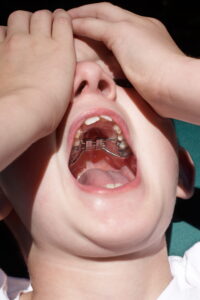
A palatal expander gently widens a narrow upper jaw over several weeks. This corrects crossbites and creates room for crowded teeth. Because the upper jaw is still in two halves during childhood, expansion is comfortable and effective at this age.
Partial appliances and space maintainers
Sometimes only a few teeth need early guidance, so a partial appliance is placed rather than a full set. A space maintainer is a small device that holds open the gap left by a baby tooth that fell out too soon, so the permanent tooth has room to erupt.
Habit-correcting appliances
For children who struggle with thumb sucking or tongue thrusting, a habit appliance provides a gentle reminder that helps stop the behavior. Removing the habit early lets the bite recover before permanent damage sets in. A review of current pediatric approaches describes these tools in the comprehensive review of pediatric care trends.
Pros and Cons of Early Treatment
Early treatment has clear benefits for the right child, but it is not needed for every child. The key is matching the treatment to a genuine developmental problem rather than starting care simply because a child has reached a certain age.
Benefits of starting early
Early care can correct crossbites, guide jaw growth, reduce the risk of injury from protruding teeth, and simplify later treatment.
Early care makes sense when
- There is a crossbite or underbite
- The upper jaw is clearly too narrow
- Front teeth protrude and are at risk of injury
- A thumb or tongue habit is reshaping the bite
- Baby teeth are lost early, and space is closing
Watchful waiting is better when
- Crowding is mild, and teeth are still erupting
- The bite is developing normally
- Problems can be handled in one phase later
- The child is not ready to cooperate with an appliance
- The only concern is cosmetic and can wait
When watchful waiting is the better choice
For many children, monitoring is the wiser path. Starting too early can mean a longer overall treatment time without added benefit. A careful provider will recommend waiting when a single later-phase option can achieve the same result.
What to Expect at Your Child’s First Visit in Orange, CA
Your child’s first visit is a relaxed evaluation, not a treatment day. At Titan Dental in Orange, CA, we gather records, review growth, and explain whether care is needed now or later.
Records and photos
We take photos and, when helpful, images of the teeth and jaw to see how growth is progressing beneath the surface.
Bite and growth review
We check how the upper and lower teeth meet, how much space is present, and whether any habits are affecting development.
Personalized recommendation
We tell you plainly whether to begin Phase 1 care, monitor for now, or plan for a single phase later on.
Care plan and next steps
If treatment is recommended, we review the appliance, the timeline, and how it fits with your child’s routine dental care.
Questions to ask at the visit
Helpful questions include: Does my child truly need Phase 1 now, or can we wait? What problem are we trying to solve? What happens if we monitor instead? How long will each phase last? Asking these keeps the conversation honest and clear.
How Phase 1 fits with your child’s overall dental care
Phase 1 works best alongside good routine care. Healthy teeth and gums support any appliance, so regular cleanings and any needed restorative dentistry should continue throughout treatment. Coordinating both under one roof keeps your child’s whole mouth healthy while the bite is being guided.
For families who later explore clear aligner options as teens, our practice also offers Invisalign. If your child eventually uses aligners, the trays should be worn all the time, except during daily oral hygiene, to get the best result. For pricing on aligner care, contact our Orange, CA office at 714-990-3321.
At Titan Dental, Dr. Thuy B. Le, a Blue Diamond Invisalign Provider, is committed to delivering exceptional dental care with a focus on personalized, compassionate treatment. She strives to create a comfortable, welcoming environment for every patient, ensuring each visit is tailored to individual needs and promotes optimal oral health. Dr. Le’s dedication to using the latest dental technologies and adhering to the highest standards of safety and hygiene reflects her unwavering commitment to her patients’ well-being and satisfaction. Trust Dr. Le and the Titan Dental team to help you achieve and maintain a beautiful, healthy smile.
Frequently asked questions
Q: What does Phase 1 mean in orthodontics?
Phase 1 refers to early, interceptive treatment given to a child, usually between ages 6 and 10, when some baby teeth are still present. It guides jaw growth and creates space for adult teeth rather than aligning the whole smile.
Q: What is the difference between Phase 1 and Phase 2 treatment?
Phase 1 addresses developing growth and bite problems in young children, while Phase 2 aligns the full set of permanent teeth in older children or teens. Phase 1 lays the foundation, so Phase 2 is usually simpler.
Q: What are the three phases of orthodontic treatment?
The three parts are planning and evaluation, active treatment, and retention. Active treatment may involve a single-phase or two-phase approach, and retention uses a retainer to hold the teeth in their new positions.
Q: Does every child need Phase 1 treatment?
No. Many children do not need Phase 1 and are better served by monitoring, with a single later phase if needed. Phase 1 is recommended only when there is a genuine problem such as a crossbite, narrow jaw, protruding teeth, or a harmful oral habit.
Want to schedule an appointment now? Follow our directions, use this helpful Google Maps link, or get step-by-step navigation via Get Directions.
We serve Santa Ana, Tustin, Tustin Foothills, Anaheim, Garden Grove, Placentia, Fullerton, Irvine, Yorba Linda, Fountain Valley, Westminster, Stanton, Costa Mesa, Brea, and Buena Park, California.
We also proudly serve the City of Orange, the City of Irvine, the City of Villa Park, the City of Anaheim Hills, and our neighboring communities.
Remember: Schedule your child’s first evaluation by age 7 so that any bite or growth concerns can be caught when they are easiest to address.
Disclaimer: This article is for general information only and is not a substitute for a personal evaluation by a qualified dental provider.